
Complete solution · AtoN House Nordic
Aquaculture site marking
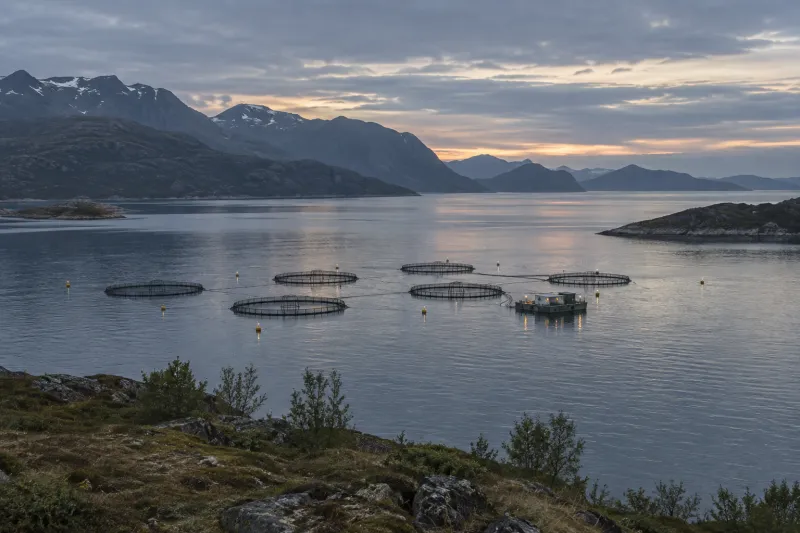
Aquaculture marking combines boundary buoys and equipment lights specified for the approved site plan.
Commissioning verifies the status, alarms and controls supported by each connected instrument.
The components
Equipment
and interfaces
6 components with specified functions.
The labels identify their Emiko integration.
- 01Structure
Navigation buoys
Yellow special-mark buoys
Provide boundary marks with the specified yellow topmarks; hull size and freeboard follow the farm site conditions.
Product page - 02Structure
Navigation buoys
Mooring, ballast and topmark
Complete the specified mark; mooring and ballast follow depth, seabed, tides, exposure and equipment loading.
Product page - 03No telemetry
LED marine lanterns
MSM MCL 360 boundary lanterns
Provide the approved yellow character from integrated solar power; this configuration has no telemetry.
Product page - 04No telemetry
Marker lights
Daniamant ML 200 marker
Provides local battery-powered spar marking only where its colour and character meet the approved equipment plan.
Product page - 05No telemetry
Marker lights
Daniamant ML 300 marker
Provides local flange-mounted equipment marking from a specified 10 to 27 VDC supply, without telemetry.
Product page - 06Full Emiko integration
PowerGuard
PowerGuard supply
Supplies the calculated load from battery and optional solar charging; reports its own status and alarms to Emiko.
Product page
How it works
From the plan to the
commissioned installation
The site plan defines the marking positions. Light selection follows the mounting, power and operating requirements.
- 01
Review plan
The authority-approved plan defines boundary marks, yellow characters, topmarks and any synchronisation requirement.
- 02
Select lights
Select buoys, moorings and MCL 360 boundary lanterns for depth, tides, exposure and seasonal autonomy.
- 03
Confirm characters
Select ML variants for local equipment only where their characters are suitable; size the ML 300 external supply.
- 04
Install equipment
Install the moorings, buoys and equipment lights; verify positions, characters and any specified synchronisation.
- 05
Plan inspections
Test PowerGuard supply alarms and record inspections, battery replacement, cleaning and mooring service.
Where it is used
Aquaculture boundaries and equipment
Aquaculture operators and contractors preparing marking specifications for marine farm installations.
- 01
A cage farm adjacent to vessel traffic
- 02
A mussel or seaweed installation with marked boundaries
- 03
A feed barge and associated service pontoons
Planning
Delivery scope
and equipment options
Delivered by Vikingegaarden
- Equipment specification from the marking plan, site data and operating requirements
- Component supply with the agreed manufacturer documentation
- Installation and commissioning, or technical support for the appointed contractor
- Emiko configuration and acceptance checks for supported equipment interfaces
- Service scope, inspection requirements and spare parts confirmed in the quotation
Good to know
Before the
quotation
Can the lights be synchronised?
MCL 360 GPS synchronisation can be specified where the selected variant supports the required farm marking character. The ML product page does not document synchronisation, so ML 200 and ML 300 are not substituted for synchronised boundary lanterns.
How is battery replacement planned?
Runtime is confirmed on request for the selected battery light and operating character. ML 300 uses an external supply. The maintenance plan sets inspection and replacement intervals for the installation.
What is required for a quotation?
The enquiry requires the approved site plan, marking positions, colours and characters, mounting details and available supplies. Exposure, required visibility and inspection access should also be included.
Plan this solution
Project quotation
The specification defines the equipment, installation scope and price.
The enquiry requires a chart, positions, marking requirements, mounting details, available power and required autonomy.